AR
AR
 English
 Urdu
Urdu
 Hindi
Hindi
 Bengali
 Indonesian
 Filipino
 Nepali
 中文
中文
MCB vs MCCB vs RCCB vs RCBO: Which Breaker Goes on Which Circuit?
MCB vs MCCB vs RCCB vs RCBO: function, amperage range, and mounting point for each, plus median price from Almadah's catalog (thousands of breakers, Sep 16, 2026).
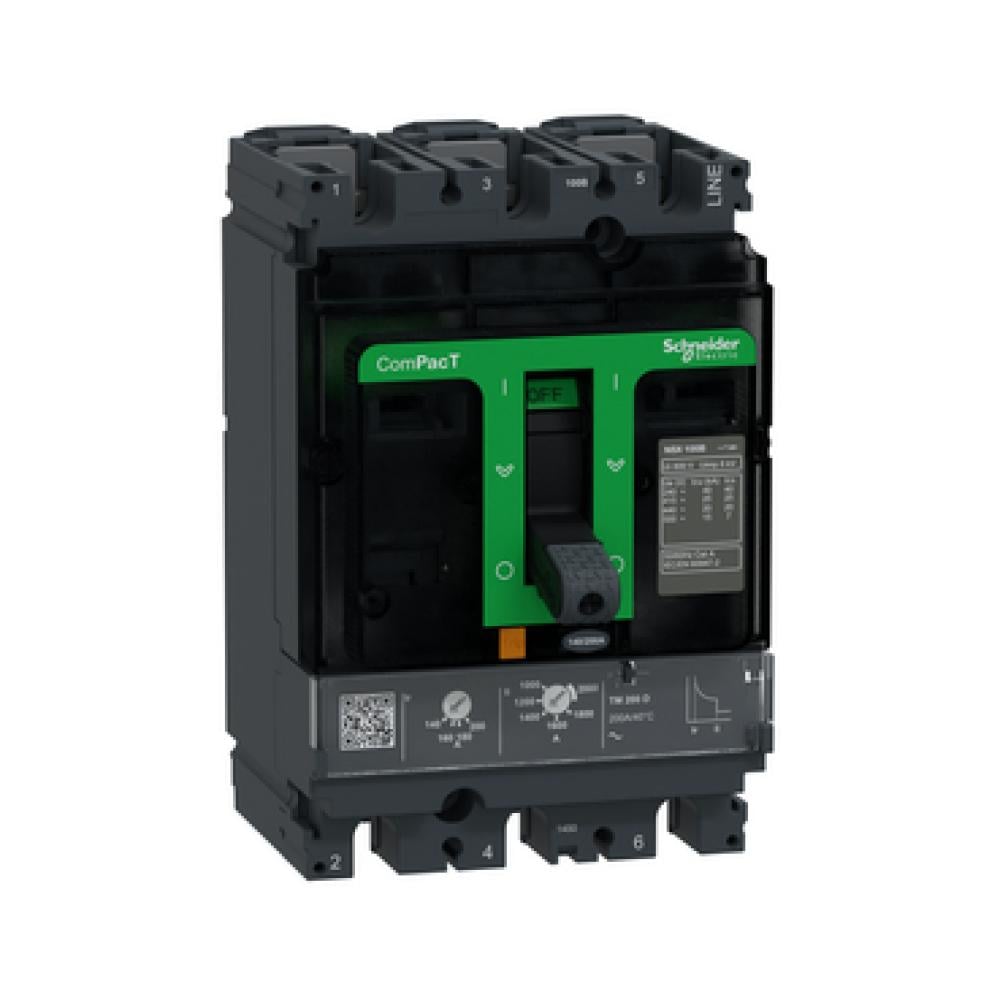
Direct answer: An MCB trips on overload and short circuit in standard residential circuits. An MCCB does the same job at much higher currents on the main board, with some frames rated up to 1600A. An RCCB trips only on earth leakage — it gives no overload protection at all. An RCBO combines MCB and RCCB protection in one device. Almadah's catalog carries large numbers of MCBs and MCCBs, and smaller numbers of RCCBs and RCBOs.
What's the quick comparison table for MCB, MCCB, RCCB, and RCBO?
| Type | Function | Amperage range | Mounting point | Median price at Almadah* |
| MCB | Trips on overload and short circuit | 1–125A | Sub-board, per standard residential circuit (lighting, sockets) | SAR 91.08 |
| MCCB | Same function as MCB, in a molded housing rated for higher current and breaking capacity | From the trip unit's adjustable setting up to 1600A depending on the frame | Main board at the building's power entry point, or retail/industrial panels | SAR 802.00 |
| RCCB | Trips only on earth leakage — no overload protection | 16–100A | Bathrooms, kitchens, outdoor circuits | SAR 267.95 |
| RCBO | Combines MCB and RCCB protection in one device | 10–45A | Same locations as RCCB, when a single dedicated breaker per circuit is preferred | SAR 195.50 |
*VAT-inclusive (15%), and this is the median, not the average, from Almadah's catalog dated Sep 16, 2026 (pre-assembled distribution boards where a breaker type is listed as a spec, not a standalone product, are excluded). Full price ranges: MCB SAR 9.98–621.00, MCCB SAR 104.65–9,302.86, RCCB SAR 67.90–2,994.44, RCBO SAR 105.66–721.00.
What's the difference between trip curves B, C, and D, and which suits which load?
The trip curve sets how many times the rated current triggers an instant trip on inrush — it has nothing to do with protection against a sustained overload:
- Curve B — trips at 3–5x rated current. For purely resistive loads (lighting, heaters) that need a fast, sensitive trip.
- Curve C — trips at 5–10x. The standard choice for Saudi residential and commercial wiring because it tolerates mixed-load inrush without nuisance tripping. Most breakers in Almadah's catalog are listed as Curve C, versus far fewer for Curve B and Curve D.
- Curve D — trips at 10–20x. For motors, AC units, and compressors with high inrush current.
What do the Schneider catalog terms Acti9, Compact, and Easy9 mean?
Schneider Electric leads the breaker category at Almadah with a clear majority of products, spread across series built for different uses:
| Series | What it is | Products | Covers |
| Acti9 | Schneider's standard residential/commercial line, including the iC60 (MCB) and the Vigi add-on module (RCCB) | Hundreds (mostly iC60, with a few Vigi) | MCB · RCCB · RCBO |
| Compact NSX | Molded-case (MCCB) line across multiple current frames, up to 1600A | Hundreds (mostly NSX within the Compact line) | MCCB |
| Easy9 | Budget-tier line for cost-sensitive residential projects | Hundreds | MCB · RCBO |
| EasyPact (EZC) | Budget-tier molded-case (MCCB) line | Dozens | MCCB |
| Domae | Simplified residential/light-commercial line | Dozens | MCB |
Which breaker do you actually need?
- A standard lighting or socket circuit inside an apartment or villa — an MCB rated to match the feeding cable's size, typically 6–20A on Curve C.
- A bathroom, kitchen, or any outdoor socket circuit — RCCB or RCBO, since the Saudi Electrical Code requires earth-leakage protection at these points.
- A single critical circuit that needs both protections without taking up two breaker slots on the board — RCBO, though it costs more than a separate MCB and RCCB combined.
- The building's main power entry point, or a retail/industrial panel with large loads — MCCB, sized to the whole board's load, not a single circuit.
The exact amperage to pick per household load (AC, water heater, kitchen) matched to cable size is covered in an upcoming How-To article in this cluster.
Related links
- Almadah's Circuit Breakers category — thousands of products.
- The full guide: Circuit Breakers and Distribution Boards in Saudi Arabia.
Frequently asked questions
What's the core difference between MCB and MCCB?
Both trip on overload and short circuit, but an MCB is built for residential circuits at lower amperage (up to roughly 125A), while an MCCB's molded housing handles much higher current and breaking capacity, up to 1600A on some frames.
When do I need an RCCB instead of an MCB?
An RCCB gives no protection against overload or short circuit at all — it trips only on earth leakage. That's why it's always paired with a separate MCB, or replaced by an RCBO, in bathrooms, kitchens, and outdoor circuits.
What is an RCBO, and why is it sometimes preferred over a separate MCB and RCCB?
An RCBO is a single device that combines overload/short-circuit protection (the MCB function) with earth-leakage protection (the RCCB function). It saves board space by taking one slot instead of two, but its median price at Almadah (SAR 195.50) is higher than an MCB alone.
What's the difference between Curve B, C, and D?
It's about trip speed on inrush: B trips at 3–5x rated current, C at 5–10x, and D at 10–20x for motors and AC units with high inrush current. Curve C is the most common in Almadah's catalog.
What do Acti9, Compact, and Easy9 mean in Schneider's catalog?
Acti9 is Schneider's standard residential/commercial line (covering MCB, RCCB, and RCBO), Compact/NSX is the molded-case (MCCB) line for larger loads, and Easy9 is a budget-tier line for cost-sensitive projects.
Can an MCCB be used in a residential distribution board?
In practice, rarely — an MCCB is typically the main breaker at a building's power entry point, or used in retail/industrial panels, while a villa or apartment board relies on MCBs and RCCBs/RCBOs at the sub-circuit level.
Does an RCCB protect against overload?
No. An RCCB trips only on earth leakage, never on overload or short circuit — which is why it must always sit behind an MCB that covers those risks, or be replaced by an RCBO.
What's the lowest amperage an MCCB starts at in Almadah's catalog?
The lowest-rated MCCBs in the catalog start from an adjustable trip-unit setting on smaller frames, while larger frames scale up to 1600A — unlike an MCB, which typically tops out at 125A.
Which breaker does the Saudi Electrical Code require in bathrooms and kitchens?
The Saudi Electrical Code requires earth-leakage protection in bathrooms, kitchens, and outdoor circuits — met either with a separate RCCB behind an MCB, or with a single RCBO doing both jobs.